
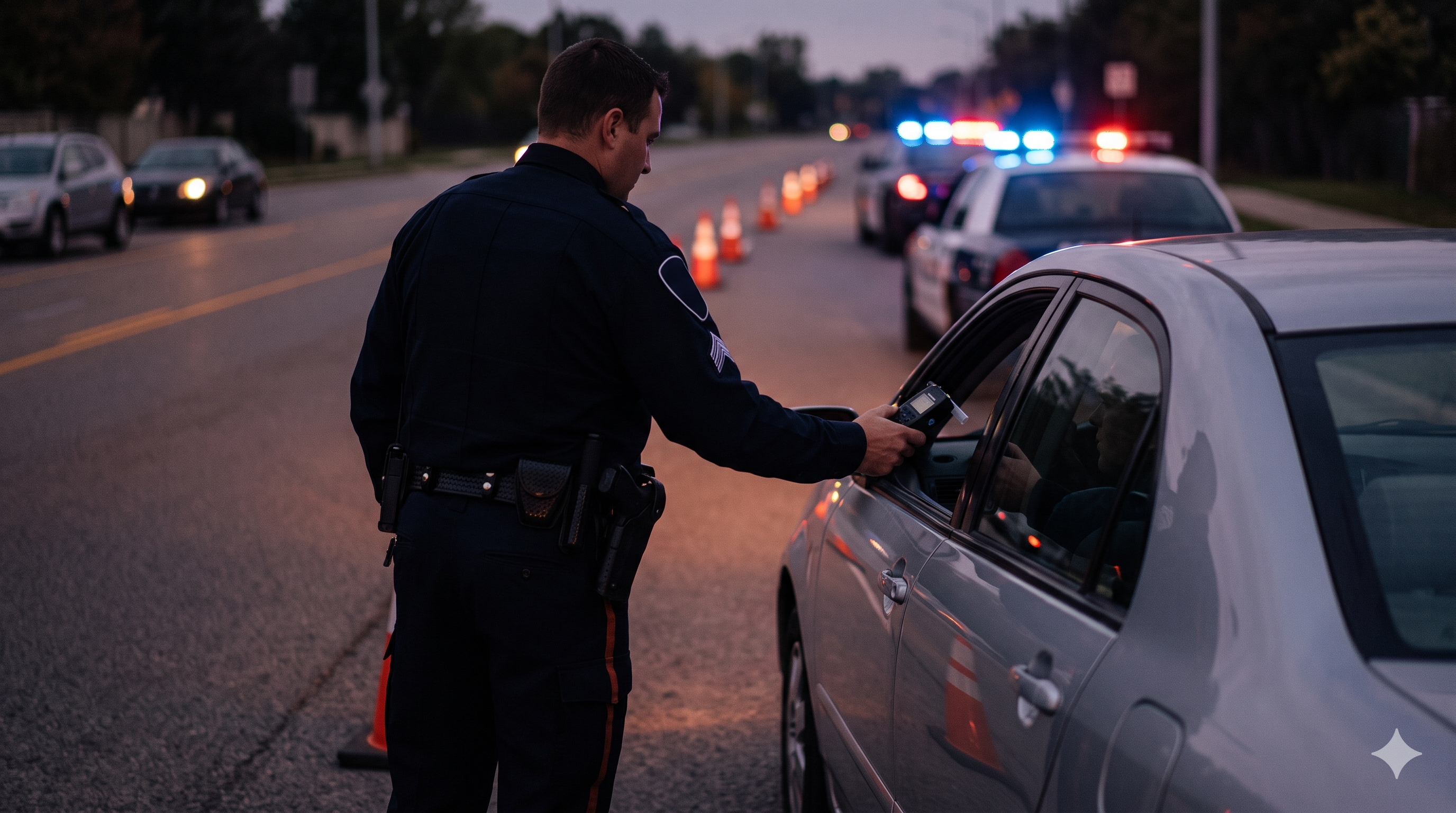
FIRST.— DUI and drug-impaired driving
You were tested and it came back positive, or you believe the test wasn’t done properly. This can be either a traffic violation or a criminal offense, depending on the exact reading and the circumstances.
Once your breath-alcohol level exceeds 0.60 mg/l, driving stops being just a fine and becomes a criminal offense under Spanish law. The law allows for three possible penalties — imprisonment of 3 to 6 months, a fine of 6 to 12 months, or community service — and the judge applies only one of them, not all three together. That said, the driver’s license suspension (1 to 4 years) is always imposed, regardless of which penalty is chosen.
In practice, if it’s your first offense and there was no accident, a fine is the typical outcome, not prison time. Prison is reserved for repeat offenders or more serious circumstances.
The same applies to drugs: there’s no specific threshold required — it’s enough to show you were driving under their influence.
SECOND.— Speeding
Not every case of excessive speed is a crime — most are simply traffic tickets. It becomes a criminal offense when you exceed the speed limit by 60 km/h (about 37 mph) on urban roads or 80 km/h (about 50 mph) on highways.
THIRD.— Reckless driving
Driving with blatant recklessness, creating a specific danger to people’s life or physical safety, is a criminal offense: 6 months to 2 years in prison and a driving ban of 1 to 6 years.
If it involves clear disregard for other people’s lives, the penalty rises to 2 to 5 years in prison, a fine of 12 to 24 months, and a driving ban of 6 to 10 years. If no actual danger to anyone’s life or physical safety materialized, the penalty is 1 to 2 years in prison, a fine of 6 to 12 months, and that same 6-to-10-year driving ban.
FOURTH.— Refusing a breath or drug test
Refusing to submit to a legally required alcohol or drug test is a criminal offense on its own, even if it’s never proven you were actually driving under the influence: 6 months to 1 year in prison and a driving ban of 1 to 4 years.
FIFTH.— Driving without a valid license
Driving after your license has lost validity due to a total loss of points, after a court-ordered suspension (temporary or permanent), or without ever having obtained a license, is a criminal offense: 3 to 6 months in prison, a fine of 12 to 24 months, or 31 to 90 days of community service.
SIXTH.— Creating a serious traffic hazard
Placing unforeseeable obstacles on the road, spilling slippery or flammable substances, tampering with or removing traffic signs, or failing to restore road safety when legally required to, is a criminal offense: 6 months to 2 years in prison, or a fine of 12 to 24 months together with 10 to 40 days of community service.
SEVENTH.— What I always check
- Whether the test was administered correctly, with all the legal safeguards required
- Whether you were offered a second, confirmatory test, and whether your right to request one was respected
- Whether the reading or the circumstances actually justify a criminal charge, or whether there’s room for it to stay a traffic violation instead
- Whether the judge can reduce the sentence by one degree due to the lower level of risk involved (possible for these offenses)
EIGHTH.— What you can achieve
- If the test had any procedural flaw, the evidence may not hold up
- A quick plea agreement for the lowest possible penalty, if the evidence is solid and you’d rather close the case fast
- A full trial defense, if there’s real room for acquittal or a reduced sentence
NINTH.— Shall we talk?
If you’ve been tested for alcohol or drugs, accused of reckless driving, or you’re facing any road safety issue, let’s talk before the case moves forward.